The Life of the Morels
The opening of the book began with a description of the setting (The Bottom). As we continue we get into the life of the Morels. Mrs Morel formally known as Gertrude Coppard is now married for eight years and has the children William her first born son who is eight years and Annie who is nine years.
At first we look we see a very sad woman who is sick of the poverty and meanness she had to endured. She was also sick of her husband and his drinking.
In chapter one we can also see how close William is to his mother and he never wants to leave her side.The is displayed at the wake(festival) where Mrs Morel left with Annie because she is not so much into it and her son William does not enjoy the fair after she has left. At the fair he won a prize for his mother because to him no one is as pretty as she is.
Mrs. Morel went into a series of flashback where we could understand her life before her marriage. Her father was an engineer and they were reasonable happy. At nineteen she received a Bible from a man name John Field. She also remembers the night she meet Mr. Morel and how happy she was for the first six months then she realized Mr. Morel (husband) keep an unpaid bill away from her then the curiosity stated. Another event which occurred was the cutting of her son Williams hair which made her very upset. Then the couple had a big fight over Mr. Morel going out with his wife friend.
At the ending of chapter one the book returns to the present.
These flashback are at the opening of the book by D.H Lawrence to ensure the readers get an understanding of the Morel Family.
Thursday, January 12, 2012

Thursday, September 15, 2011
Question 1
Have you ever been betrayed? Give an example of when you were betrayed, how did you feel and what did you do.
Yes I have been betrayed. As young people there are many times individual who are really close to us have betrayed us. Many different emotions may overshadow our minds however; the one which may jump out quickly is sadness especially if the person was close to you.
I have been betrayed on many occasions but this situation is one I will remember vividly. I school as a young child I had one best friend in which I trusted dearly. I told her a deep secret a day when I felt really down and urged her not to mention it to anyone.
My mom always told me every friend has a better friend and it took me a log while to understand what it really meant. It was a couple months after I told my friend that secret a fellow classmate and I got into a heated argument. During the commotion she blurted the secret I told my best friend. I was shock, angry and really sad.
The next day I went to my best friend and asked her if she repeated the secret to anyone. At first she denied she ever said anything however, after a while she came clean and told me everything.
To be honest I was so angry it took me awhile to speak to her again but the Bible speaks about forgiveness. I did forgive but I never forgot what she did. Till this day we are friends but the closeness we had before dwindled into the sunset because of betrayal.
Question 2
Have you ever felt betrayed and in the end misunderstood the situation?
Yes I felt betrayed and in the end I misunderstood the situation. As students we may think persons in authority betrayed us with an unfair grade or even a severe punishment however what we do not understand it is for our betterment in life. A few years back while I was I high school a teacher was looking out for my best interest and I misunderstood the situation. As student we are not suppose to miss class however is use to skip classes to do other home work.
The teacher realized I was skipping classes and called my parents up to school. There was a meeting and I was severely punished by my mother. A few years later I realised that this teacher was not trying to hurt or even betray me she was only trying to help me excel ad be the top.
There are many times we feel like someone have betrayed us however, if we asset the situation you may come to realize people who care about us will go the extra mile even though we may not get the expected action.
Question 3
Look at various Shakespeare plays over the years you have studies.
Why do the characters always seem to resort to violence, trickery and evilness?
The books in which I have studied and will elaborate on are Romeo and Juliet and Much Ado about Nuttin by William Shakespeare.
In these two books I have studied the main characters seem to resort to violence, trickery and evilness. While studying Romeo and Juliet and Much Ado About Nuttin the main theme which stood out is love. In these text there is antagonist or villains who always seek to create conflict among the lovers.
In Romeo and Juliet the families of these two lover caused the death of the both lovers.
In much Ado about Nuttin Claudio and Hero were also in love however, the villain Don John stirred up anger and stiff among the lovers.
In most of William’s play the antognist always causes conflict between charters. With that conflict it leads to violence, trickery and evilness causing a major character I the play to suffer tremendously.
Winter’s Tale

At the center of the play is a royal family separated by tragedy, and their miraculous reunification provides the play's happy ending. Prior to 1603, England had gone a long time without a full royal family: Elizabeth had been childless and unmarried, meaning that England had a majestic Virgin Queen who was worshipped and adored. But they had no full royal family that they could look to as a model for their own families, no central family to act as a symbolic microcosm for the larger family of the English nation. In 1603, James I ascended to the throne, and suddenly England had such a family. This significant event undoubtedly influenced the writing of The Winter's Tale.
Because Shakespeare took no interest in the publication of his plays, his drama got into print in uncertain and unreliable ways. It is difficult to say which plays, if any, come to us straight from Shakespeare's manuscripts. Corrupt texts abound. The Winter's Tale was never published during Shakespeare's life. The play was first printed in 1623, in the collection of plays known as the First Folio. Modern publications of the play are based directly on this First Folio printing.
The Elizabethan Theatre
Elizabethan theatre and the name of William Shakespeare are inextricably bound together, yet there were others writing plays at the same time as the bard of Avon. One of the most successful was Christopher Marlowe, who many contemporaries considered Shakespeare's superior. Marlowe's career, however, was cut short at a comparatively young age when he died in a tavern fight in Deptford, the victim of a knife in the eye.
The history of the theater is fascinating. How plays were first produced in the yards of inns - the Inn-yards. The very first theater and the development of the amphitheatre! The Elizabethan Entrepreneurs ( the men with the ideas and the money!). The building, design and construction of a London Elizabethan Theatre. The plays, the playwrights, the politics and the propaganda all play an important part in the history of the Elizabethan Theatre. The Elizabethan Theatre was a booming business. People loved the Theatre! The Elizabethan plays and theatres were as popular as the movies and cinemas of the early 20th century. Vast amounts of money could be made! The inn-keepers increased their profits by allowing plays to be shown on temporary stages erected in the yards of their inns (inn-yards). Soon purpose-built playhouses and great open theatres were being constructed. The great success of the theatre and what led to its downfall. The section covering Elizabethan Theatre includes the following subjects: § The History of the Elizabethan theatre - the Inn-Yards, the Amphitheatres and the Playhouses
§ Elizabethan Plays and Propaganda
§ Elizabethan theatre and Plays banned from London City Limits
§ The Puritans and the demise of the Elizabethan Theatre

Global Theatre
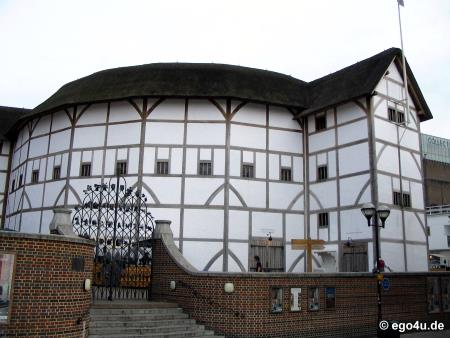

The Global Theatre was owned by actors who were also shareholders in Lord Chamberlain's Men. Two of the six Global Theatre shareholders, Richard Burbage and his brother Cuthbert Burbage, owned double shares of the whole, or 25% each; the other four men, Shakespeare, John Heminges, Augustine Phillips, and Thomas Pope, owned a single share, or 12.5%. (Originally William Kempe was intended to be the seventh partner, but he sold out his share to the four minority sharers, leaving them with more than the originally planned 10%).These initial proportions changed over time as new sharers were added. Shakespeare's share diminished from 1/8 to 1/14, or roughly 7%, over the course of his career.
The Global Theatre was built in 1599 using timber from an earlier theatre, The Theatre, which had been built by Richard Burbage's father, James Burbage, in Shoreditch in 1576. The Burbages originally had a 21-year lease of the site on which The Theatre was built but owned the building outright. However, the landlord, Giles Allen, claimed that the building had become his with the expiry of the lease. On 28 December 1598, while Allen was celebrating Christmas at his country home, carpenter Peter Street, supported by the players and their friends, dismantled The Theatre beam by beam and transported it to Street's waterfront warehouse near Bridewell. With the onset of more favourable weather in the following spring, the material was ferried over the Thames to reconstruct it as The Globe on some marshy gardens to the south of Maiden Lane, Southwark. The new theatre was larger than the building it replaced, with the older timbers being reused as part of the new structure; the Globe was not merely the old Theatre newly set up at Bankside. It was probably completed by the summer of 1599, possibly in time for the first production of Henry V and its famous reference to the performance crammed within a "wooden O".The first performance for which a firm record remains was Jonson's Every Man out of His Humour—with its first scene welcoming the "gracious and kind spectators"—at the end of the year.

William Shakespeare
William Shakespeare made himself very famous by writing 154 Sonnets and numerous highly successful oft quoted dramatic works including the tragedy of the Prince of Denmark, Hamlet;
Shakespeare was born on the 23rd April 1564 on Henley Street in Stratford, England, a bustling market town on the Upper Avon River in the county of Warwickshire, about ninety miles northwest of London.
In his younger years Shakespeare attended the Christian Holy Trinity church, the now famous elegant limestone cross shaped cathedral on the banks of the Avon river, studying the Book of Common Prayer and the English Bible. In 1605 he became lay rector when he paid 440 towards its upkeep, hence why he is buried in the chancel. Early on Shakespeare likely attended the Elizabethan theatrical productions of travelling theatre troups, come to Stratford to entertain the local official townsmen, including the Queen's Men, Worcester's Men, Leicester's Men, and Lord Strange's Men. There is also the time when Queen Elizabeth herself visited nearby Kenilworth Castle and Shakespeare, said to have been duly impressed by the procession, recreated it in some of his later plays.
Although enrolment registers did not survive, around the age of eleven Shakespeare probably entered the grammar school of Stratford, King's New School, where he would have studied theatre and acting, as well as Latin literature and history. When he finished school he might have apprenticed for a time with his father, but there is also mention of his being a school teacher. The next record of his life is in 1582, when still a minor at the age of eighteen and requiring his father's consent, Shakespeare and Anne Hathaway (1556-1623) married in the village of Temple Grafton. Baptisms of three children were recorded; Susanna (1583-1649), who went on to marry noted physician John Hall, and twins Judith (1585-1662) who married Richard Quiney, and Hamnet (1585-1596) his only son and heir who died at the age of eleven.
Shakespeare wrote most of his plays as `quarto texts', that being on a sheet of paper folded four ways. A few of his plays were printed in his lifetime, though they appeared more voluminously after his death, sometimes plagiarised and often changed at the whim of the printer. First Folio would be the first collection of his dramatic works, a massive undertaking to compile thirty-six plays from the quarto texts, playbooks, transcriptions, and the memories of actors. The approximately nine hundred page manuscript took about two years to complete and was printed in 1623 as Mr. William Shakespeares Comedies, Histories, & Tragedies. It also featured on the frontispiece the famous engraved portrait of Shakespeare said to be by Martin Droeshout (1601-1651).
Under the favour of the court The Kings' Men became the eminent company of the day. Most likely Anne and the children lived in Stratford while Shakespeare spent his time travelling between Stratford and London, dealing with business affairs and writing and acting. In 1616 his daughter Judith married Quiney who subsequently admitted to fornication with Margaret Wheeler, and Shakespeare took steps to bequeath a sum to Judith in her own name. William Shakespeare died on 23 April 1616, according to his monument, and lies buried in the chancel of the Holy Trinity Church in Stratford upon Avon. While there is little known of her life, Anne Hathaway outlived her husband by seven years, dying in 1623 and is buried beside him. It is not clear as to how or why Shakespeare died, but in 1664 the reverend John Ward, vicar of Stratford recorded that "Shakespeare, Drayton and Ben Johnson had a merie meeting, and itt seems drank too hard, for Shakespeare died of a feavour there contracted." His tombstone is inscribed with the following epitaph.
Poetry
It is generally agreed that most of the Shakespearean Sonnets were written in the 1590s, some printed at this time as well. Others were written or revised right before being printed. 154 sonnets and "A Lover's Complaint" were published by Thomas Thorpe as Shake-speares Sonnets in 1609. The order, dates, and authorship of the Sonnets have been much debated with no conclusive findings. Many have claimed autobiographical details from them, including sonnet number 145 in reference to Anne. The dedication to "Mr. W.H." is said to possibly represent the initials of the third earl of Pembroke William Herbert, or perhaps being a reversal of Henry Wriothesly's initials. Regardless, there have been some unfortunate projections and interpretations of modern concepts onto centuries old works that, while a grasp of contextual historical information can certainly lend to their depth and meaning, can also be enjoyed as valuable poetical works that have transcended time and been surpassed by no other.
Evoking Petrarch's style and lyrically writing of beauty, mortality, and love with its moral anguish and worshipful adoration of a usually unattainable love, the first 126 sonnets are addressed to a young man, sonnets 127-152 to a dark lady. Ever the dramatist Shakespeare created a profound intrigue to scholars and novices alike as to the identities of these people.
Tragedies
Some probably inspired by Shakespeare's study of Lives (trans.1597) by Greek historian and essayist Plutarch and Raphael Holinshed's Chronicles (1587). Some are reworkings of previous stories, many based on English or Roman history. The dates given here are when they are said to have been first performed, followed by approximate printing dates in brackets, listed in chronological order of performance.
Titus Andronicus first performed in 1594 (printed in 1594),
Romeo and Juliet 1594-95 (1597),
Hamlet 1600-01 (1603),Julius Caesar 1600-01 (1623),
Othello 1604-05 (1622),
Antony and Cleopatra 1606-07 (1623),
King Lear 1606 (1608),
Coriolanus 1607-08 (1623), derived from Plutarch
Timon of Athens 1607-08 (1623), and
Macbeth 1611-1612 (1623).
Romeo and Juliet 1594-95 (1597),
Hamlet 1600-01 (1603),Julius Caesar 1600-01 (1623),
Othello 1604-05 (1622),
Antony and Cleopatra 1606-07 (1623),
King Lear 1606 (1608),
Coriolanus 1607-08 (1623), derived from Plutarch
Timon of Athens 1607-08 (1623), and
Macbeth 1611-1612 (1623).
Histories
Shakespeare's series of historical dramas, based on the English Kings from John to Henry VIII were a tremendous undertaking to dramatize the lives and rule of kings and the changing political events of his time. No other playwright had attempted such an ambitious body of work. Some were printed on their own or in the First Folio (1623).
King Henry VI Part 1 1592 (printed in 1594);
King Henry VI Part 2 1592-93 (1594);
King Henry VI Part 3 1592-93 (1623);
King John 1596-97 (1623);
King Henry IV Part 1 1597-98 (1598);
King Henry IV Part 2 1597-98 (1600);
King Henry V 1598-99 (1600);
Richard II 1600-01 (1597);
Richard III 1601 (1597); and
King Henry VIII 1612-13 (1623)
King Henry VI Part 2 1592-93 (1594);
King Henry VI Part 3 1592-93 (1623);
King John 1596-97 (1623);
King Henry IV Part 1 1597-98 (1598);
King Henry IV Part 2 1597-98 (1600);
King Henry V 1598-99 (1600);
Richard II 1600-01 (1597);
Richard III 1601 (1597); and
King Henry VIII 1612-13 (1623)
Taming of the Shrew first performed 1593-94 (1623),
Comedy of Errors 1594 (1623),
Two Gentlemen of Verona 1594-95 (1623),
Love's Labour's Lost 1594-95 (1598),
Midsummer Night's Dream 1595-96 (1600),
Merchant of Venice 1596-1597 (1600),
Much Ado About Nothing 1598-1599 (1600),
As You Like It 1599-00 (1623),
Merry Wives of Windsor 1600-01 (1602),
Troilus and Cressida 1602 (1609),
Twelfth Night 1602 (1623),
All's Well That Ends Well 1602-03 (1623),
Measure for Measure 1604 (1623),
Pericles, Prince of Tyre 1608-09 (1609),
Tempest (1611),
Cymbeline 1611-12 (1623),
Winter's Tale 1611-12 (1623).
Comedy of Errors 1594 (1623),
Two Gentlemen of Verona 1594-95 (1623),
Love's Labour's Lost 1594-95 (1598),
Midsummer Night's Dream 1595-96 (1600),
Merchant of Venice 1596-1597 (1600),
Much Ado About Nothing 1598-1599 (1600),
As You Like It 1599-00 (1623),
Merry Wives of Windsor 1600-01 (1602),
Troilus and Cressida 1602 (1609),
Twelfth Night 1602 (1623),
All's Well That Ends Well 1602-03 (1623),
Measure for Measure 1604 (1623),
Pericles, Prince of Tyre 1608-09 (1609),
Tempest (1611),
Cymbeline 1611-12 (1623),
Winter's Tale 1611-12 (1623).

Theatre of Absurd

The origins of the Theatre of the Absurd are rooted in the avant-garde experiments in art of the 1920s and 1930s. At the same time, it was undoubtedly strongly influenced by the traumatic experience of the horrors of the Second World War, which showed the total impermanence of any values, shook the validity of any conventions and highlighted the precariousness of human life and its fundamental meaninglessness and arbitrariness. The trauma of living from 1945 under threat of nuclear annihilation also seems to have been an important factor in the rise of the new theatre.
At the same time, the Theatre of the Absurd also seems to have been a reaction to the disappearance of the religious dimension form contemporary life. The Absurd Theatre can be seen as an attempt to restore the importance of myth and ritual to our age, by making man aware of the ultimate realities of his condition, by instilling in him again the lost sense of cosmic wonder and primeval anguish. The Absurd Theatre hopes to achieve this by shocking man out of an existence that has become trite, mechanical and complacent. It is felt that there is mystical experience in confronting the limits of human condition.
As a result, absurd plays assumed a highly unusual, innovative form, directly aiming to startle the viewer, shaking him out of this comfortable, conventional life of everyday concerns. In the meaningless and Godless post-Second-World-War world, it was no longer possible to keep using such traditional art forms and standards that had ceased being convincing and lost their validity. The Theatre of the Absurd openly rebelled against conventional theatre. Indeed, it was anti-theatre. It was surreal, illogical, conflict less and plotless. The dialogue seemed total gobbledygook. Not unexpectedly, the Theatre of the Absurd first met with incomprehension and rejection.
One of the most important aspects of absurd drama was its distrust of language as a means of communication. Language had become a vehicle of conventionalised, stereotyped, meaningless exchanges. Words failed to express the essence of human experience, not being able to penetrate beyond its surface. The Theatre of the Absurd constituted first and foremost an onslaught on language, showing it as a very unreliable and insufficient tool of communication. Absurd drama uses conventionalised speech, clichés, slogans and technical jargon, which is distorts, parodies and breaks down. By ridiculing conventionalised and stereotyped speech patterns, the Theatre of the Absurd tries to make people aware of the possibility of going beyond everyday speech conventions and communicating more authentically. Conventionalised speech acts as a barrier between ourselves and what the world is really about: in order to come into direct contact with natural reality, it is necessary to discredit and discard the false crutches of conventionalised language. Objects are much more important than language in absurd theatre: what happens transcends what is being said about it. It is the hidden, implied meaning of words that assume primary importance in absurd theatre, over and above what is being actually said. The Theatre of the Absurd strove to communicate an undissolved totality of perception - hence it had to go beyond language.
Absurd drama subverts logic. It relishes the unexpected and the logically impossible. According to Sigmund Freud, there is a feeling of freedom we can enjoy when we are able to abandon the straitjacket of logic. In trying to burst the bounds of logic and language the absurd theatre is trying to shatter the enclosing walls of the human condition itself. Our individual identity is defined by language, having a name is the source of our separateness - the loss of logical language brings us towards a unity with living things. In being illogical, the absurd theatre is anti-rationalist: it negates rationalism because it feels that rationalist thought, like language, only deals with the superficial aspects of things. Nonsense, on the other hand, opens up a glimpse of the infinite. It offers intoxicating freedom, brings one into contact with the essence of life and is a source of marvellous comedy.
There is no dramatic conflict in the absurd plays. Dramatic conflicts, clashes of personalities and powers belong to a world where a rigid, accepted hierarchy of values forms a permanent establishment. Such conflicts, however, lose their meaning in a situation where the establishment and outward reality have become meaningless. However frantically characters perform, this only underlines the fact that nothing happens to change their existence. Absurd dramas are lyrical statements, very much like music: they communicate an atmosphere, an experience of archetypal human situations. The Absurd Theatre is a theatre of situation, as against the more conventional theatre of sequential events. It presents a pattern of poetic images. In doing this, it uses visual elements, movement, light. Unlike conventional theatre, where language rules supreme, in the Absurd Theatre language is only one of many components of its multidimensional poetic imagery.
Sunday, September 11, 2011
Literature Home Work

Act one of the main sections of a play or other performance
Scene may be defined a subdivision of an act.
Exposition is the part of a book that sets the stage for the drama to follow it also introduces the themes, settings, characters, and circumstances at the story’s beginnings.
Conflict may be defined as the problem or struggle on which the story is based.
Complication is the event or character whose introduction into a story which causes difficulties.
Climax is the highest point of the narrative.
Denouement is the solution or unraveling of the plot in a play or story
Peripeteia is the sudden reversal of fortune in a story, play or any narrative in which there is an observable change in direction.
Characterization is the process of depicting characters and personality in a narrative so that the characters seem real.
Protagonist is the main and most important character in a novel, play, story or other literary work.
Antagonist is a character, group of characters, or an institution, that represents the opposition against which the protagonist must contend.
Main Plot may be defined as a story is basically what happens and the main problem
Sub Plot is a secondary plot strand that is a supporting side story for the main plot.

Comedy a funny play, flim or TV show that has a happy ending.
History is a play which is based on historical events.
Tragedy is a serious play with a sad ending.
Romance is a frictional narrative dealing with exciting and extravagant adventures or romantic setting.
Tragicomedy is fictional work that blends in with the genres of tragedy and comedy.
Theatre of the Absurd is a theatrical style originating in France in the late 1940's. It relies heavily on existential philosophy, and is a category for plays of absurdist fiction.
Satire may be defined as the experience vices, follies, abuses, and shortcomings are held up to ridicule, ideally with the intent of shaming individuals, and society itself, into improvement.
Modern Drama speaks loudly and lucidly to multiple parties and can articulate struggle and redemption in a matter that makes it understandable to all in the modern society.
Melodrama refers to a dramatic work which exaggerates plot and characters in order to appeal to the emotions.

Monologue is when the character may be speaking his or her thoughts aloud, directly addressing another character, or speaking to the audience, especially the former.
Dialogue is a literary and theatrical form consisting of a written or spoken conversational exchange between two or more people.
Soliloquy is a device used in drama It is the process where a character relates his or her thoughts and feelings to him/herself and to the audience without addressing any of the other characters, and is delivered often when they are alone or think they are alone.
Aside is a line spoken by an actor that the other characters on stage supposedly cannot hear.
Set is the place or area where the actors perform when a scene is being shot.
Stage Directions are the directions given to the actors by the director. They involve physical movement by the actors on stage.
Stage Conventions deal with the engineering products tied to the story and how those ties affect the audience's response eg. costume, lighting, sound effects, stage position, backdrops and props.
Chorus is a homogenous, non-individualized group of performers, often in the plays of classical Greece, who comment with a collective voice on the dramatic action of the play or narrative.
Dramatic Unities may be defined as the three unities of time, place and action observed in classical drama.
Disguise is to change the appearance of one’s self so as to conceal identity or to mislead, as by means of deception.
Literary Devices
Imagery is a descriptive language that evoke sensory experiences.
Motif is any reoccurring element that has symbolic significance in a story.
Symbolism may be defined as the artistic method of revealing ideas or truths through the use of symbols.
Dramatic Irony may be defined as an irony that is inherent in speeches or a situation of a drama and is understood by the audience but not grasped by the characters in the play.
Tragic Irony are words and actions used by the characters of a play to contradict the real situation, which the spectators fully realize.
Juxtaposition two objects or texts that oppose to one another.

Social Context the identical or similar social levels and social roles as a whole that influence the individuals of a group interacts.
Historical Context reflects the time in which something takes place or was created and how it influences, how you interpret it.
Political Context reflects the environment in which something is produced indicating it's purpose or agenda
Religious Context this reflects the belief of someone what a person believes in.
Ethnic Context reflects the characteristics of people or a group, sharing common and distinctive culture, religion or language.
Moral Context is concerned with the judgment of the goodness or badness of human action and character.
Intellectual Context This deals with the mental process, educational background and behavior of an individual.
Cultural Context the way in which the person was raised or how she/she grew up.
Subscribe to:
Posts (Atom)